Ocotillo Spotlight on Instructional Technology
Note: The Ocotillo Spotlight is no longer published, but all previous issues will remain on this site.
spotlight for June 2001
For this issue of the Ocotillo Spotlight we feature students from J.D. Mildrew's Calculus and Physics classes at South Mountain Community College. At the May 2001 Ocotillo Retreat, this group of students developed and taught a lesson on analyzing data to Maricopa faculty and staff to demonstrate how they use graphing calculators and spreadsheets to solve problems. Mary Long visited with some of these students and recorded a series of brief video interviews with them.
Doug Sawyer
Ocotillo Faculty Chair
doug.sawyer@scmail.maricopa.edu
Students Show How Technology Supports Active Learning In Physics and Calculus
Mary Long, Ocotillo Faculty Chair, South Mountain Community College
Walk into J.D. Mildrew's math and physics classroom any day of the week unannounced - or at least that's what I did- and you see a classroom full of focused activity ranging from experiments to student-centered groups engaged in problem solving. Never mind that it's the last half hour of a 3 hour class. The students are animated, engaged, (they are oblivious to my entrance) and, yes, learning.
J.D. knows they are learning because for several years he has been assessing his students with a standardized test normed nationally on data collected from students in 4-year college physics programs. He and his students have much of which to be proud. They rank with or above other college physics students. But formal assessments aside, his classroom is a teacher's dream of seeing students interacting and engaging in learning with technology.
I talked with several students impromptu, including, Ismael Paderez, a South Mountain Community College student majoring in computer science engineering. 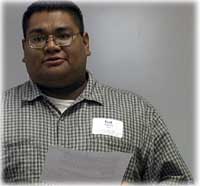 He is also considering a career in teaching. You can hear that in the way he discusses the learning process, the classroom interaction, and the use of technology. I had met him recently when he organized and delivered a presentation for the 2001 Ocotillo Retreat.
Along with fellow students Cheryl Hernandez, Ron Riley, Carlos Gonzales, and Jose Chavarria, he explained the design of the learning environment in the physics and mathematics program. Students work in groups using laptops and Microsoft Excel, the TI 83 graphing calculator, and Scientific Notebook software to solve real-life problems. They demonstrated that these technologies can be used not only to design presentations but are powerful and useful ways to develop the kinds of expertise and practical high tech life-skills that have concrete applications outside the classroom.
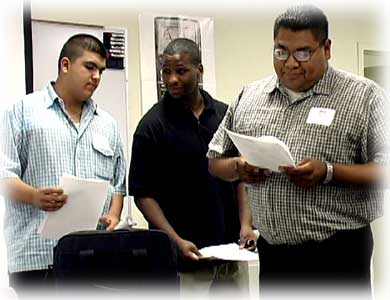
Carlos Gonzales, Ron Riley, and Ismael Paderez explain the medical information
and methods they will use to generate graphs and analyze the data.
The content of their Ocotillo presentation involved using an exponential model of data from studies of real life cancer patients from 1950 through 2000. They used Microsoft
Excel and the TI 83 calculators to do an exponential regression analysis of the data. They found the derivative to the function of
y=x2 * sin(x)
using the product rule and found the answer was
x2cos(x)* 2x * sin(x)
But more interesting than the content was the level of ease with which the students worked together to use technologies available to solve the problem.
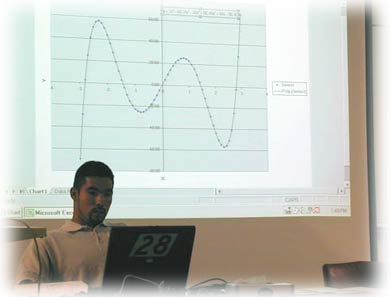
Jose Chavarria provides instructions for
the graphing of a fifth-order polynomial function in Excel.
In this approach to teaching and learning, the emphasis is on empowering students through learning with technology. J.D. truly replaces the role of the "sage on stage" with the "guide on the side." Technology is put in the hands of students not controlled by the instructor. The learning environment is designed in interactive, student-centered learning groups. The students make real-life applications of what they are learning in a dynamic process of collaboration and inquiry. The aim is to develop learners with an understanding of themselves as learners applying their inquiry to actual situations that go beyond the classroom walls.
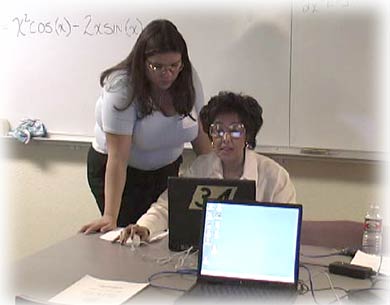
Cheryl Hernandez points out an Excel technique
for graphing an equation at the Ocotillo Retreat.
The emphasis is on the learning with technology, not technology or learning technology. And the students are aimed for the future challenges of living in a high tech world.
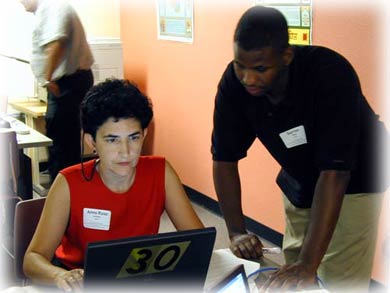
Ron Riley helps Anna Rosa Lampis (GateWay Community College)
solve a spreadhseet problem at the Ocotillo Retreat
More Student Images, Movies, and Comments
I used my Mavica digital camera to snap some images and record some video mini-interviews with some more of J.D.'s students. Hear them describe in their words what the technology has done for them.
 A slide show of images I took from a visit to JD's class and from the Ocotillo Retreat.
view slide show
 Christene describes the creative aspects of solving problems with computers
view MPEG movie [1.2 MB]
Ismael introduces himself and describes his use of graphing calculators.
view MPEG movie [1.2 MB]
Alexander and Jason tell us about their use of computers in math and physics.
view MPEG movie [1.3 MB]
Ismael shares his educational goals.
view MPEG movie [856k]
Ismael describes some of the benefits of learning with technology
view MPEG movie [1.0 MB]
Students share their experience with technology and the kinds of ways they have used these tools.
view MPEG movie [1.3 MB]
Ismael tells us how he and his fellow students worked as a team to create their Ocotillo retreat presentation.
view MPEG movie [1.0 MB]
A student shares how technology helps him visualize concepts that help him learn.
view MPEG movie [1.3 MB]
|