|

ocotillo central
Ocotillo Spotlight on Instructional Technology...
is a monthly electronic newsletter that highlights an innovative use of technology at one of the Maricopa Community Colleges.
Spotlight
current issue
« 2005 » « 2004 » « 2003 » March: Profiles of Four Faculty at South Mountain
April: Chandler-Gilbert Goes Wireless!
May: The Universe in My Classroom (Scottsdale)
June: Online Biology at Phoenix College
September: Rio Salado College Online Course Tour
October: Estrella Mountain's Blackboard "How-To" Modules
November: End-of-a-Pencil Experiences Online (Paradise Valley)
December: A Glendale Community College Hybrid Learning Pioneer: Marla DeSoto
« 2002 » « 2001 »
Ocotillo
ocotillo central
roundtables
retreats
|
Ocotillo Spotlight on Instructional Technology
Note: The Ocotillo Spotlight is no longer published, but all previous issues will remain on this site.
spotlight for May 2003
The May 2003 Ocotillo Spotlight brings you to a star-filled classroom at Scottsdale Community College. Astronomy Faculty Steve Mutz describes how, with some help from a National Science Foundation grant, a traditional space was transformed into a planetarium, providing a unique learning environment at Maricopa.
The Universe in My Classroom
written by Steve Mutz Scottsdale Community College
steven.mutz@sccmail.maricopa.edu.
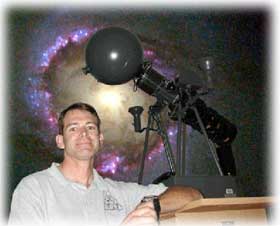
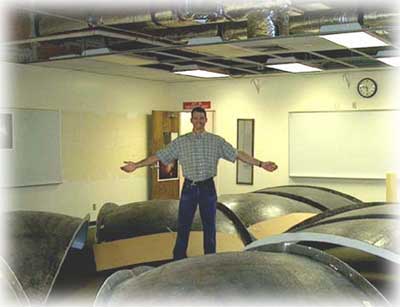
Since the Spring of 2002, Scottsdale Community College has an classroom-sized planetarium. Funded by a cost-sharing grant from the National Science Foundation, the planetarium is used as a teaching aid for SCC's Astronomy classes, as well as astronomy shows open to the public.
This new classroom environment allows students to imagine that they are outside. Instead of focusing on the front of the classroom where the instructor is usually located, students now will place their attention on the ceiling.
The planetarium resides in a converted classroom in the Physical Sciences building and can seat as many as 24 people. The heart of the planetarium is a $25,000 star projector built in Japan by the Goto Corporation, a company that has designed and built planetarium equipment since the 1920's.
Also installed is a surround sound system and digital projector run by a laptop computer. This gives the planetarium the capability for multi-media displays, including slide shows, animations, digital movies, music, and internet-based presentations.
The planetarium can give views of the sky for any day of the year, from any location on Earth north of the Equator, for any year. Over 1500 stars are projected onto the planetarium dome, as well as the Milky Way, the planets, Sun, and Moon with its phases. Besides looking at the planets, stars, sun, and moon, the planetarium can provide a perspective outside the earth. I can also show students solar eclipses - why and how they happen, and can even simulate
that process.
"Most people have a small passing interest in astronomy; hopefully our planetarium will further stimulate that interest."
The night-time sky simulator has three main pieces: a dome, projector, and seating. I can simulate what can be seen outside, from any place on earth, any time of the day, any year, past and
future. The simulator has the capacity to speed up time, and it can show you things in a few minutes which normally takes months in actuality.
The planetarium is the only one among the Maricopa Community Colleges. There is one similar to ours at Arizona State University, there's the very large one at the downtown
Phoenix Science Center.
The planetarium is now open for free shows to the public the first and third Saturday afternoons each month at 4:00 and 4:45 p.m. Because of the limited seating capacity, shows are by reservation only. Anyone interested in attending a show can contact Steve Mutz, SCC Physical Sciences Department, at 480-423-6122 or by email at steven.mutz@sccmail.maricopa.edu.
|