Ocotillo Spotlight on Instructional Technology
Note: The Ocotillo Spotlight is no longer published, but all previous issues will remain on this site.
spotlight for August 2001
Every month the Ocotillo Spotlight shines on a different college. For August of 2001, Rey Rivera has been selected as the target from Estrella Mountain Community College. In a series of video interviews, Rey talks about technology, his courses and teaching methods.
Doug Sawyer
Ocotillo Faculty Chair
doug.sawyer@scmail.maricopa.edu
(Technology + Math) * Rey Rivera = Student Success at Estrella Mountain
written by Dawn Mullan(Estrella Mountain Community College)
video by Randy Anderson (Estrella Mountain Community College)
Rey Rivera (rey.rivera@emcmail.maricopa.edu) is a mathematics faculty member as well as Division Chair of
Science and Mathematics at Estrella Mountain Community College. Rey
describes his efforts toward technology as: "...my own natural thing. I
have always liked working with computers." For an instructor open to the
use technology in his classroom, as a student his opportunities utilizing
technology was small. Rey remembers, "In college, every single math class that I took I was not even allowed to use a calculator."
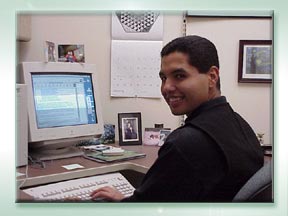
Rey Rivera working on his Blackboard course materials.
His college years were a far cry from the college he
was about to enter. "When I came into the Maricopa Community Colleges
five years ago at Estrella Mountain,
I saw technology being incorporated into everything," he says. Utilizing
technology was a natural progression for Rey, "So it really didn't
take much of an effort for me to ease into using some sort of technology in the
classroom."
Rey began witnessing the benefits through his
students' achievements. The incorporation of technology into his courses
allows Rey to expand his instruction and give students the needed foresight
into the real world application of mathematics. Rey explains, "In math,
we use graphic calculators (two-dimensional representations) extensively. And,
so I wanted to find ways to entice my students to learn that would make it
relevant to them.
Rey Rivera believes technology's positive impact on
his students is worth any inconvenience of learning new applications. He
reasons, "I just think that if it makes it easier for my students learn
mathematics then I really have no qualms about using anything. I mean, granted
it might take some time for me to learn to use it myself, but the end justifies
the means if it equals student success."
Enhancing
his courses with technology, Rey learns that technology assists in information,
communication, and assessment as well as his lectures. "Since we use Blackboard
here at Estrella Mountain,
I am able to get my students copies of all my handouts. So if a student loses a
handout or the courses syllabus, they can get it off the web. I also have
announcements on Blackboard.
Communicating changes or upcoming tests and quizzes, Blackboard
is a real help," Rey expounds.
Rey
adds, "The assessment part is probably the most convenient for my
students and myself. It allows me to give my students instant feedback. As
opposed to collecting the assignment, having to grade it, handing it back
several days later long after the questions were pertinent." Now Rey has
the ability of immediate feedback and classroom discussions about the material.
With
his use of technology in special projects, Rey has his own favorites sites.
"I like to use NBA.com.
They have all the statistics from previous years all archived for the fans.
These clear statistics are perfect for my projects," he states.
"Also, the government's census site (Census Bureau)
is another good one. They have population data dating back from the early 19th
Century. Students can utilize these statistics to see population trends in the
states over a period of time."
The
use of graphing calculators and Blackboard are not the only ways Rey bring reality
to mathematics. "I use LiveMath for
my calculus courses. This application allows students to graph
three-dimensional objects and surfaces," he illustrates. "I also
like LiveMath as
software due its versatility. I can load what LiveMath calls
"notebooks" into Blackboard. As students do their homework at home,
they can access LiveMath through
my Blackboard site and actually graph from home when students need it
most."
Rey is trying out new software Respondus to
aid in his assessment. "It will allow me to create my assessments in an
easier fashion. Before I had to do copy and paste in to different programs, now
I can my assessments in one shot," he articulates. Respondus will
allow Rey to have multiple versions of various assessments at his disposal.
Rey
may or may not ever teach completely online. He likes the interaction he has
with students. He would like technology to grow and allow him the ability to he
real time discussions with his class. He expresses, "I want technology to
be able to make math as simple as it can be. I want something that'll let
me communicate with my students effectively." Perhaps in the near future,
Rey will get his wish.
As technology expands and reaches
new horizons, so are students progressing and learning as technology shows them
new ways to look at mathematics-two-dimensionally, three-dimensionally, and
into the real world. As Rey has experienced in his courses, technology
integration into the classroom has left an indelible mark in favor of student
success.
|