|

ocotillo central
Ocotillo Spotlight on Instructional Technology...
is a monthly electronic newsletter that highlights an innovative use of technology at one of the Maricopa Community Colleges.
Spotlight
current issue
« 2005 » « 2004 » January: Traditional Tellers Add a Digital Touch to their Travels (South Mountain)
February: Using Technology to make Learning Real (GateWay)
March: Snapshots of Technology in Scottsdale's Science Labs
April: WebCT Testing Center at Phoenix College
May: What is an ePortfolio? Chandler-Gilbert Knows!
June: Keeping Up With Technology is Tough! (MATEC)
October: PC Media Services: Better, Stronger, Faster (Now with IP Link™)
« 2003 » « 2002 » « 2001 »
Ocotillo
ocotillo central
roundtables
retreats
|
Ocotillo Spotlight on Instructional Technology
Note: The Ocotillo Spotlight is no longer published, but all previous issues will remain on this site.
spotlight for June 2004
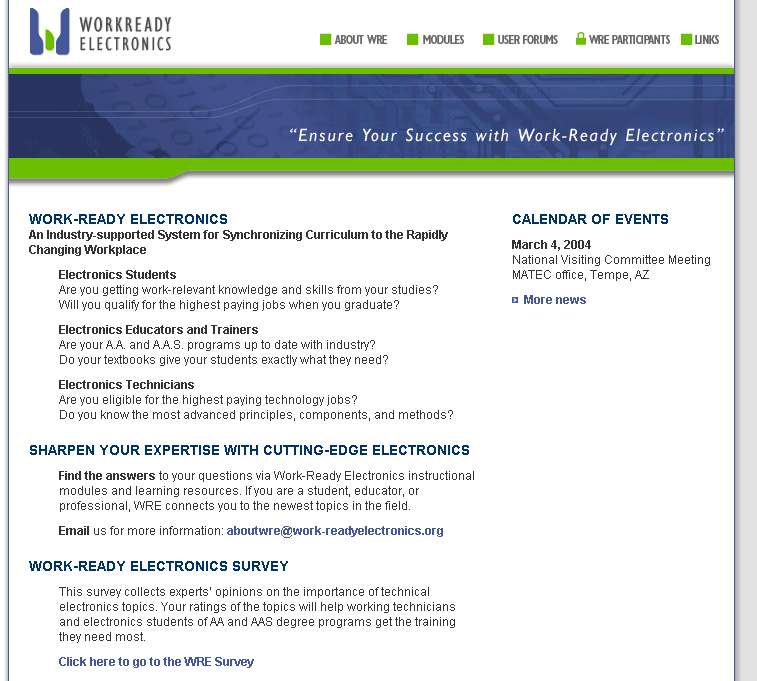
For the June 2004 Ocotillo Spotlight focuses on the modules and web features of the Work Ready Electronics project being developed by Maricopa Advanced Technology Education Center (MATEC).
Keeping Up With Technology is Tough!
written by Joseph Mattoon Maricopa Advanced Technology Education Center (MATEC)
Electronics seems to advance at light speed! For example, how often have you been told you need to update your computer again in the past 10 years? Electronics programs within our community colleges must not fall behind if we are to supply employers with graduates and upskilling technicians who possess the "cutting-edge" technical knowledge and skills needed to be successful and productive. Enter Work-Ready Electronics: An Industry-supported System for Synchronizing Curriculum to the Rapidly Changing Workplace. The WRE web site provides both technical to-be-learned content and a variety of interactive learning activities, resources to explore, and knowledge/skill assessment instruments that are ready to use by instructors who wish to leverage this opportunity.
Electronics is Big
There is a huge variety of interesting and lucrative technician jobs in electronics, but employers hire first those with cutting-edge knowledge. Companies save money if they can hire "work-ready" AAS degreed graduates and send their employees to community colleges to up-date their knowledge instead of developing their own in-house training. Keeping courses up-to-date via WRE has immediate value to students, teachers, colleges, and employing companies.
Accessibility
WRE modules can be accessed on a 24-7 basis from the web and easily integrated within existing courses and programs. Each standalone module provides learner-centered instruction that maximizes students' capability to study and prepare for lab activities, performance assessments, and in-depth discussions with instructors.
Foundation and Dissemination
WRE is supported by a $900,000, 3-year grant, funded by the National Science Foundation's Advanced Technology Education program.  The grant is being conducted at the Maricopa Advanced Technology Education Center (MATEC). Like several other MATEC projects, WRE provides up-to-date modularized technical instruction to Maricopa and other community college districts nationwide via the Internet. WRE instructional modules are designed, developed, evaluated, and revised to keep colleges current with industry practices via partnerships with Mesa, Glendale, and Austin Community Colleges and a task force composed of both faculty and industry subject matter experts.
Web Resources and Modular Design
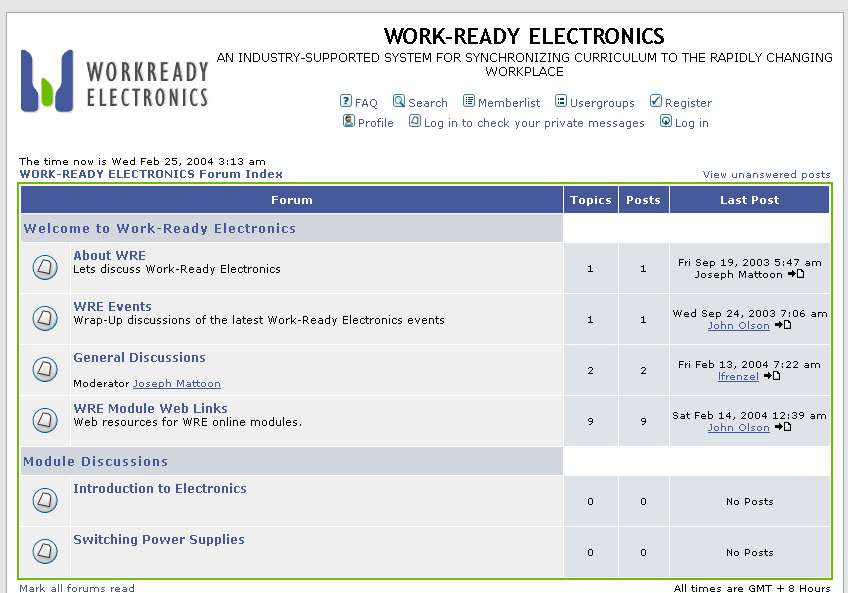
Having the advantage of being delivered on the web, the designers of Work-Ready Electronics have provided many other useful features for learning, teaching, and collaborating. For example, the WRE Forums organizes and provides immediate access to threaded discussions of technical topics, teaching tips, graphics, and other information to be exchanged and shared. Important links to other web sites, such as supporting organizations, special topics (e.g., women in technology), and electronics vendors and employers of technicians are also accessible. Any users of the site can take advantage of these features.
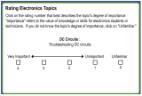 |
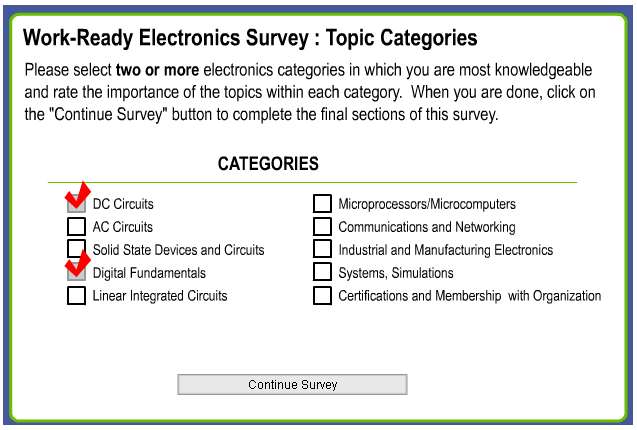
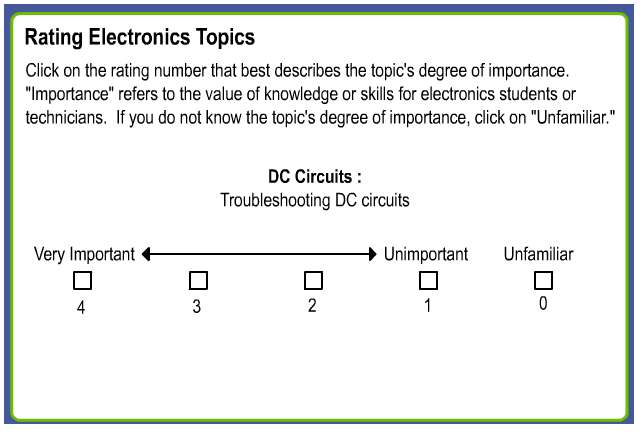
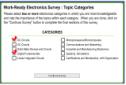
The WRE interactive Electronics Topics Survey enables industry representatives and faculty electronics experts to rate the importance of electronics topics that are being planned for future modules. Respondents are encouraged to enter new topics that are important to employers and should be included in college electronics curriculum and topics that are outdated and should be dropped or reduced in electronics programs. The survey stores data in an organized html format that is then downloaded into a spreadsheet or statistical application for analysis. Results of the survey and data analysis are used to identify new topics, help instructors integrate new material, and validate the knowledge and skill objectives of the WRE curriculum.
Development Strategy
WRE developers employ MS Word and PowerPoint which are familiar to faculty and easy for them to use to create the instruction. Finished drafts are then transformed into web-ready material using Flash and Adobe applications for text content, simulations, static graphics (e.g., digitized pictures and diagrams), and video. The process involves the initial content development by an experienced author of electronics curriculum followed by the design and production of several different learning and instructional support components. WRE team members meet frequently to assess progress, plan future modules, organize work schedules, and improve the production process.
Components of WRE Modules
There are a number of components within each WRE module that ensure effective usability for instructors and successful learning by students.
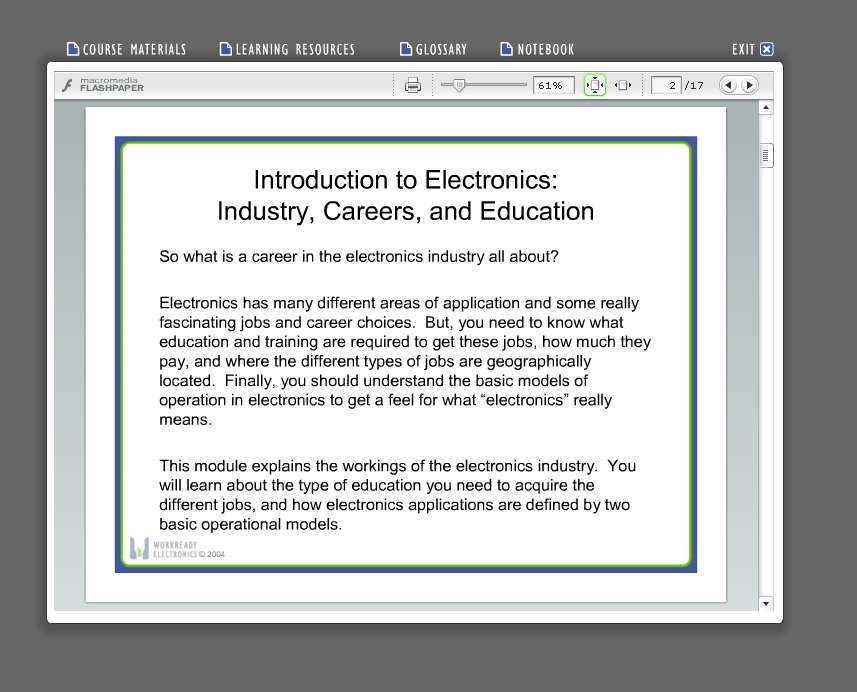
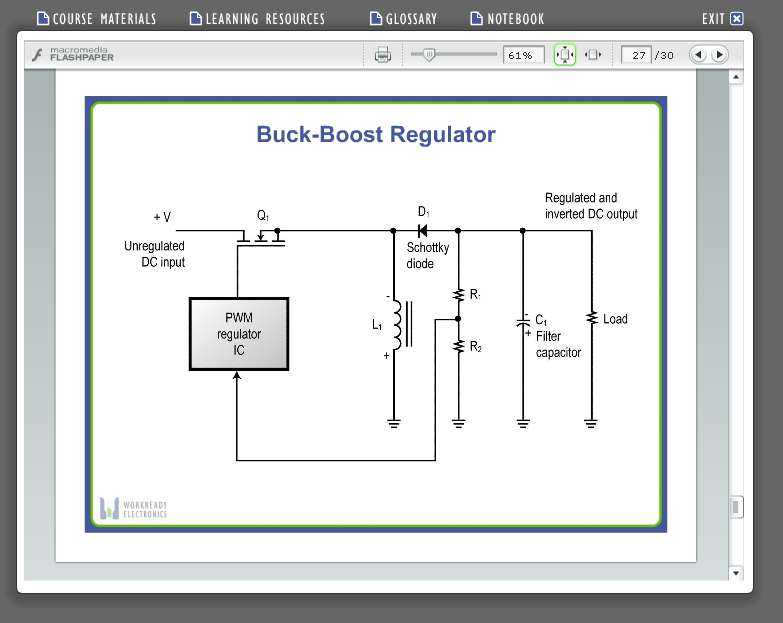
Narrative: This component outlines the topic area of the module, reports "what technicians need to know," and provides sufficient text and graphic information. When combined with the other module components, narratives reduce teaching loads by enabling students to master critical knowledge areas even before meeting the instructor or coming to class! Narratives are separated into sections that improve readability and reduce cognitive load when learning new and complex facts and concepts.
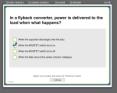
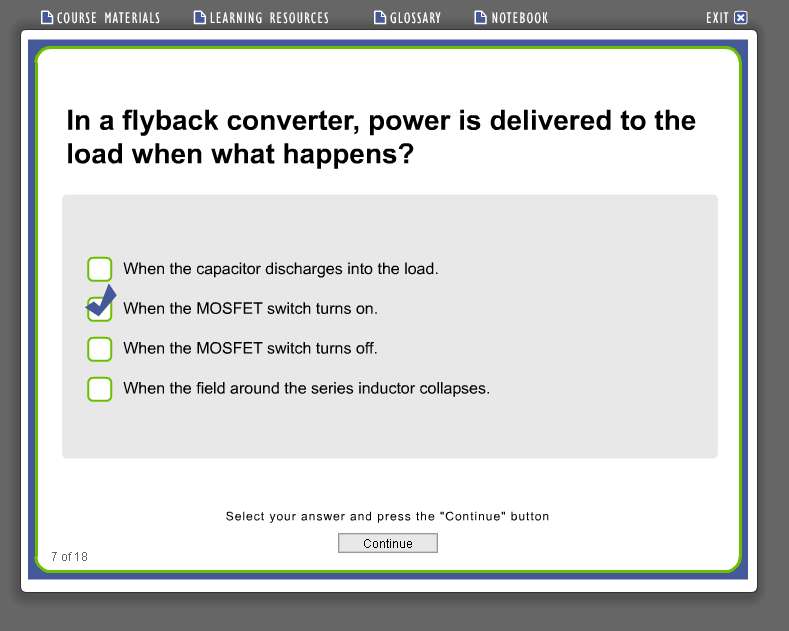
Knowledge Probes: KPs provide students with practice on the content they study and correspond to each section of the Narrative. KPs provide competency-based objectives that tell learners exactly what they are expected to know and be able to do before completing the Performance Assessment (final test) at the end of the module. The objectives are followed by a quiz that assesses the student's grasp of the content. Students can email their scores directly to the instructor. Instructors can view all student scores with relevant statistics that identify important issues such as most frequent errors, average scores, and most difficult content areas.
On-Line Study Tools: Two types of interactive study tools have been designed for WRE modules:
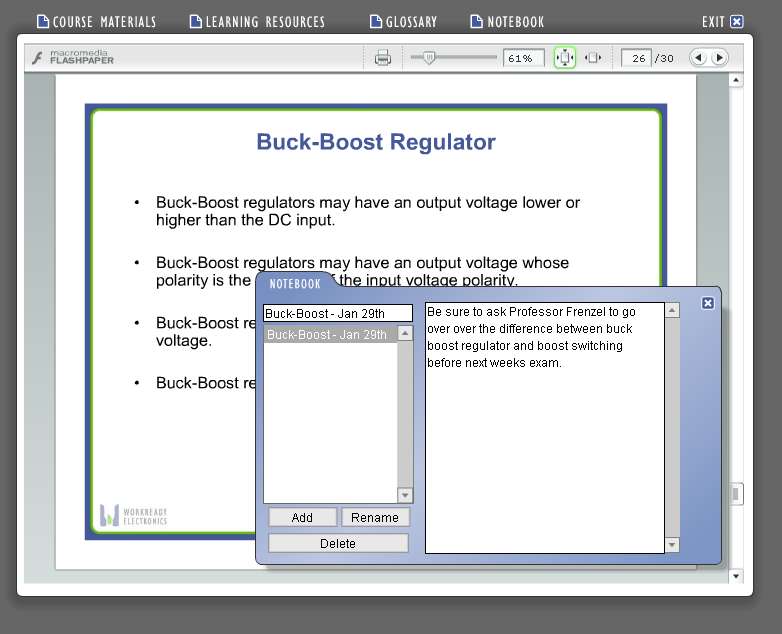
- WRE Notes is an interactive application that enables students to enter notes, name each note, and save notes on their computer for future study.
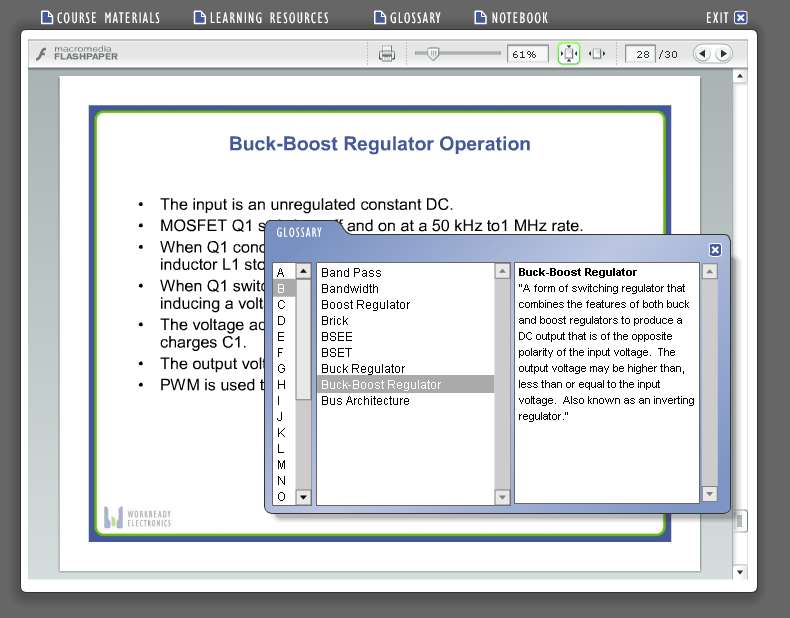
- WRE Glossary provides definitions for all technical terms used in the content. The glossary can include both text and graphics for examples of the target words, phrases, and associated concepts or electronic systems and components. Notes and Glossary appear in separate "floating" windows that can be moved as needed while studying.

Labs: Each module has a lab activity that enables students to apply their knowledge under supervision by the instructor. Lab procedures are printable (pdf) files that the student can print and take with them for guidance during the activity. The procedures include questions to answer, technical tasks to perform, and requirements for summarizing the experience and what was learned. Instructors are provided with a special version of the lab procedures that features an answer key and tips for teaching the lab effectively.

Drill Downs: Drill Downs encourage students to "go beyond the content" provided by the module Narrative and other materials. They may give directions and guidance for conducting Internet research on a particular topic or provide a materials list and set of procedures for conducting a hands-on lab experiment. Drill Downs are often team-based activities that require cooperation and effective workload sharing. This prepares students for the workplace and common industry team practices.
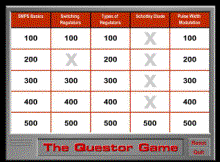
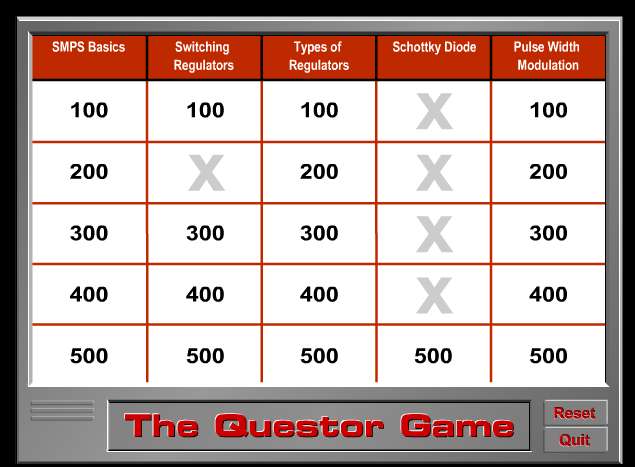
Questor Learning Games: Questor is a "content flexible" learning game that enables WRE developers to produce motivating games that can be used in class, independently, or in teams that compete for highest scores. Questor categorically arranges questions, either text-based or graphic, in an easy-to-hard format. Students respond to questions in a similar manner as used in the popular TV game, Jeopardy. The game can be accessed and immediately played at the WRE web site. Instructors can display the game on a projection screen in class to assess students' retention and accuracy of content covered in the modules.
Learn more about Questor its entry in the Maricopa Learning eXchange.
The Team
The WRE team is composed of electronics faculty from Mesa, Glendale, and Austin (Texas) Community Colleges, MATEC staff, contracted personnel, and electronics industry experts who provide consultation on relevance of the curriculum to modern business practices and products.
For further examination of this project and its products and services to the educational community, please go to www.work-readyelectronics.org and explore the current WRE Modules, WRE Forums, WRE Links, WRE Participants, and special features such as the WRE Topics survey and interactive WRE Sign-Up form. Or, call Joseph Mattoon, WRE Principle Investigator at 480-517-8655.
|