|
For the past two years, Linda Hicks and Rachel Woodburn have been co-teaching a Digital Storytelling course at Scottsdale Community College. At the January 2004 Faculty Convocation, Linda and Rachel wowed the audience with three examples of digital stories created by their students. We interviewed them by e-mail to share a bit more about their experiences.
Please tell us a bit about yourselves...
Rachel: I am a Computer Graphics Instructor at Scottsdale Community College, where I have taught in the Art department for ten years, five of which have been full-time. Most recently I have been working with photography and the manipulation of digital imagery while focusing on the creation and teaching of Digital Storytelling.
Linda: And I teach Speech Communication classes. I have taught at Scottsdale since 1984 and have been full-time faculty in the Department of Communication and Performance Arts since 1991. For the past four years, my focus has been storytelling as a teaching/learning tool. Collaboratively teaching Digital Storytelling with Rachel Woodburn has been my primary focus for the past two years.
What is your "sound-bite" length description of Digital Storytelling
Digital Storytelling is a process of connection. It is a remembrance of life stories, in combination with the power of voice and imagery. Digital Storytelling allows people to connect, using technology that's relevant to the way they live today.
Why is Digital Storytelling important now? What is the appeal to students? To faculty?
Rachel: Storytelling has always been a vital part of every community. It is how we understand who we are in relationship to others. Through story we are taught all the important lessons in life. Story preserves our history, our language, and our culture. Story is how we connect generations within community. Without story we are lost; we are without connection. Digital is just a tool that we can use to cross those bridges and reconnect community.
Everyone has a story to tell, and with the telling of the story comes connection to people, communities, and an interest in new subjects. Everyone remembers the teacher that, through story, made a subject come alive before our eyes. Through story, that teacher gave us meaning, understanding, and connection to unknown worlds.
Linda and I want to help people find their own voices, to preserve their memories, and we want to encourage people to value their diversity and unique cultures, their own histories. We believe that digital storytelling can change people's lives. Through our teaching, we try to give people the tools and knowledge they need to find their own voices, to be involved in preserving their own and their communities' stories.
How did you become involved with Digital Storytelling?
Rachel: Maricopa valued the digital storytelling process enough that, even in its early stages, they brought The Center for Digital Storytelling's Digital Bootcamp to the District in February 2000. At Phoenix College they taught faculty the process of creating digital stories. I was one of the faculty encouraged to participate. I have to say that I wasn't sure about giving up my weekend but was green enough to not say no. When I went to this bootcamp, I didn't believe I had a voice; I had no story to tell. But as I look back now, I can see that I had been telling stories all my life. We all tell stories in our own way, and this bootcamp taught me the powerful connection that you can make when you simply speak your truth.
Linda: During my 2000-2001 sabbatical project, "Oral Traditions and Storytelling as an Instructional Tool," I traveled for five months, four months in the United States and one month in France, learning about storytelling experientially. I recorded 65 hours of experiences along the way.The purpose of my sabbatical was to increase my understanding of oral traditions and storytelling as an instructional tool and as a means of enriching student learning.
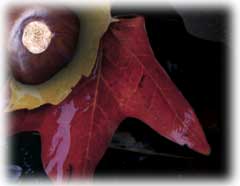
Ray Hicks was dying of bone cancer when he and his wife, Rosa, and son, Ted, invited us to their North Carolina home. Their homestead has been in the Hicks' family for generations. Ray was born in the house (heated by a pot-bellied stove) where we interviewed him. Ray told us stories, sang us songs, and signed books for us, sitting in his pajamas in front of the pot-bellied stove while chewing and spittin' tobacco. I had been invited to their home during my sabbatical travels but felt my presence would be intrusive because I knew he was ill. For over a year, Rosa and I wrote letters and she asked us to visit when Rachel, my daughter Wendy, and I attended the Jonesborough, Tennessee National Storytelling Festival. We did and were humbled by their generosity of spirit. The gift of the chestnut symbolizes, for us, the connecting power of story.
Can you describe the class you have been co-teaching at Scottsdale?
In our course, the focus is on the power of story. We create a safe learning environment and build a community within the classroom. The foundation of this course is oral storytelling and it is supported by technology as the tool for the digital creation. We wrote this course without prerequisites and simplified the technical process down so anyone without computer experience would be able to finish a digital story. Our classes are very diverse in age, ethnicity, and backgrounds.
How would you categorize the range/variety of digital stories your students have created?
The range and variety of students' stories are truly amazing. One would assume that after teaching this course for a number of terms, that they would start to sound the same or be similar. The opposite is true. There may be similar truths but each story reflects the experiences of the teller.
Each term we are reminded how powerful our voices are and how different we all are. Our perceptions are all unique, and these differences are reflected in each story. If we all told the same story and had experienced the same event, even then every story and every voice would be unique.
What technologies are used in the class? What do the students leave with in terms of a "product?"
How do you clarify or describe the role of technology to your students? We utilize Macintosh computers and Apple programs, iMovie, iDVD, GarageBand, along with Adobe Photoshop. Equipment used may be as simple as objects on a scanner along with a variety of photographs. Some students may use digital video cameras for video clips. We produce CD's, DVD's, mini DV, and VHS. Technology is just another tool, like a paint brush, a printing press, or a camera. The role of technology in the classroom is that it is a creative tool with which we develop skills on so that we can use it to share our stories and connect with our audience.
What are some of the production issues you have to address with students?
We directly address issues of copyright. The main issues we discuss in class are respect for others' art and imagery, sound, and music. It is sometimes difficult as technology makes it so easy to steal imagery and music. With younger students who grew up on computer technology, it has often become a habit with a thinly veiled excuse, "I am just a student." But this crutch doesn't push them to develop their own visual imagery and creativity.
On the music side, all of us strongly associate songs with periods of history. Songs take us back to a time and place and sometimes when we tell a story it is difficult to tell without it. If students own a CD of this song then the limiting factor is what they plan on doing with their story. When creating a personal story to show to family and friends using your CD with songs is still legal. But publishing the digital story in a multi use/platform where millions of people can view it becomes something much different. This is where students would be violating copyright laws.
Usually we stop editing when we are out of timeÉ we are always so thankful for the deadlines that force us to complete a project.
Can you share an anecdote or "story" of a student whose experience in this class was remarkable or noteworthy?
It's difficult to share just one remarkable or noteworthy story because we've found that the storytelling part of the process seems to have a powerful impact on every student and on the two of us as well.
Digital Storytelling Resources
Center for Digital Storytelling
is a non-profit project development, training, and research organization dedicated to assisting people in using digital media to tell meaningful stories from their lives.
http://www.storycenter.org/
Digital Storytelling Cookbook
The Center for Digital Storytelling provides this online tutorial that provides an overview of the process of conceptualizing a digital story, including sections on "Recipe," "7 Elements," "Getting Started," "Storyboarding," "Digitizing Memories," and "Premiere."
http://www.storycenter.org/memvoice/
pages/cookbook.html
Dana Atchley / Next Exit
Atchley, who passed away in 2000, was one of the pioneers in digital storytelling vis a vis Next Exit productions, complete with performances in front of a digital camp fire.
http://www.nextexit.com
Digital Storytelling Festival
is an annual gathering of both experts and people interested in learning more about digital storytelling. This year, the festival is June 7-12, 2004 in Sedona.
http://www.dstory.com/
The Elements of Digital Storytelling
An excellent resource site from the University of Minnesota.
http://www.inms.umn.edu/elements/
Digital Storytelling Association
http://www.dsaweb.org
|
Because we spend eight weeks finding voice, telling stories, offering feedback, and developing our final stories, the bonding that occurs builds trust. The resulting stories sometimes surprise even the teller. Some students come to class with a story they wish to tell but most students have no idea, initially, why they even signed up for the class. Through time and sharing, the stories evolve. One story or memory triggers a story and memory in the mind and heart of another student.
Usually, a student will start with a small idea but has no idea how to develop it. Through the feedback process, the entire class helps that student take the seed of an idea and tease it into a possible, full-blown story. When that happens, we are all awed by the experience. It happens every semester regardless of who is in the class. We are continually amazed by the power of story and finding our voices.
What have been some of the rewards for you as faculty in teaching this class?
There are too many rewards to list! We meet wonderfully diverse students. We hear amazing stories. We see students buy into the process and evolve before our very eyes. Because we participate as members of the class, guiding them through the process through modeling and involvement, our students view us less as experts and more as fellow classmates---just part of the storytelling process. Their voices, their feedback, their sharing becomes as important as ours.
The two of us bring very different abilities to the classroom and that has been rewarding as well. We still learn from one another. We don't have clearly defined roles although initially we did. Our thinking was that Linda's strengths would be storytelling and Rachel's strengths would be technology and graphic design. Over time, our roles have blurred.
What have been the challenges in teaching this class? What would you like to do differently?
The class is very time intensive for both of us. We meet for nearly six hours a week for 16 weeks. It's impossible for many faculty and students to sign up for the class because of the heavy time commitment. Next semester, we're late-starting the class and shortening it by one week. Because we have no pre-requisites for the class, some students have very limited computer skills so we try to keep the technology portion as simple as possible. Other students have very sophisticated computer skills but have never considered themselves storytellers. The diverse backgrounds, ages, abilities, reasons for taking the course add to the interesting mix but also add to the challenges we face. So far, we believe the benefits outweigh the drawbacks.
Your class has focused on personal stories for students (e.g. they or their family are the audience)- what is the approach or issues in working with faculty interested in using Digital Storytelling as a teaching tool? What sorts of subject areas or instructional approaches can you see this being used?
Because we've had a great deal of faculty interest in using digital storytelling as a teaching tool, MCLI is supporting our teaching a two-week summer course focusing on using the digital storytelling as a teaching/learning tool. We'll work with twelve faculty members from any discipline. We believe the process crosses discipline boundaries and that it could be useful in any teaching area. We've already worked with faculty from widely divergent disciplines (including workshops in Australia and New Zealand) and believe the major connection to be that stories connect people and tear down barriers.
Peer into your crystal ball-- What can you see going on in Maricopa with Digital Storytelling in the future?
The sky is the limit. We expect more curriculum to be written by faculty across the district. Not everyone will want to focus on personal stories. We encourage others to explore the possibilities.
|
Because of the strong interest from other faculty to learn more about Digital Storytelling, Linda and Rachel will be teaching a 40-hour summer workshop on "Bringing Digital Storytelling to the Classroom," with sessions scheduled for June 18, 19, 21, 25, 26, and 28 at Scottsdale Community College.
This workshop is an introduction to storytelling as a teaching and learning tool. Participants will explore the power of storytelling for teachers and students, and its connection to subject matter. The instructors will guide teachers with interactive exercises identifying ways to find voice, place, and memory. Teachers will work through the process of creating their own digital stories while being introduced to desktop production tools. Each teacher will create a 3-5 minute digital story preserved onto DVD, CD, mini DV, and/or VHS.
Due to extremely high demand, a second, 40-hour summer workshop on "Bringing Digital Storytelling to the Classroom" has been scheduled at Scottsdale Community College, August 9-13, 2004.
|

|